Mainnet
 TRUF.NETWORK’s Data Availability Advantage
TRUF.NETWORK is setting the new standard for data availability in decentralized finance, solving the oracle problem with unparalleled semantic compatibility, low connectivity friction, and real-time liveness.
Satoshi Nakamoto states, in the Bitcoin white paper, that the purpose of Bitcoin is to be “an electronic payment system based on cryptographic proof instead of trust, allowing any two willing parties to transact directly with each other without the need for a trusted third party.” At the highest level of analysis, Bitcoin (and every blockchain network that followed) is a system where there are no barriers to participation and where every participant, simultaneously, has total access to all system data. This absolute transparency and data availability is what allows Bitcoin to function as a permissionless, global, financial payment system that is reliant on “cryptographic proof instead of trust.” As the scope of blockchain applications has grown beyond simple transfer of value and additional data has come to be required to settle payments, the scope of what constitutes a necessary level of data availability has increased. This is particularly true in the case of markets for binary options that settle based on (real-world) events that occur outside of the activities on the blockchain network on which the trade is being settled. TRUF.NETWORK represents the new standard for data availability in the context of real world event outcomes delivered for the purposes of binary option trade settlement.
The Oracle Problem
Although the term “oracle problem” was coined in reference to transactions settled on blockchains - specifically escrow-like transactions where the outcome of some future off-chain event determines the settlement terms - the problem itself has been ubiquitous for millenia. In essence, since neither party in an escrow transactions - such as a bet settled by the outcome of some future event - can (or should) be trusted by the other party with deciding what the outcome is, a trusted third party, a “referee” or “oracle” is required to adjudicate who has won and who has lost the bet. Innumerable systems for selecting and governing oracles have been created over the centuries. From sports wagering, to futures exchanges, to the ever-growing collection of prediction markets, people who want to wager on the outcome of events in the future have found ways to do so, and to do so at scale, using trusted third parties. However, the entire blockchain revolution is testament to the idea that a system that allows market participants to interact without the need for a trusted third party is preferable to a system where a trusted third party is required. While the oracle problem does not have a technical solution, particularly in the context of escrow transactions settled on a blockchain, data availability is the key to solving the problem using economic incentives.
The Properties of Data Availability
Of course, data availability is ultimately about data being readily available for use in a given application (or set of applications). In the context of prediction markets, where the data in question is the result of a particular event - with that result being required to settle “bets” - there are several factors that determine how available that data is, in relative terms. These factors, the properties we measure to rank data availability, are semantic compatibility, connectivity friction, and liveness. TRUF.NETWORK addresses all three of these factors to demonstrably deliver the highest possible standard of data availability for decentralized trading of real world event-based binary options.
Semantic Compatibility
Semantic compatibility refers to the degree to which data is able to be immediately consumed and used by a given application. When data represents an oracle result, used in a Web3 or DeFi application, this necessarily means that the data structure must contain a cryptographic signature that verifies the identity of the oracle, such that the application can have cryptographic proof of data provenance. TRUF.NETWORK’s attestation protocol provides a standardized means of acquiring an oracle result, for any stream data in the ledger, with customizable queries (for date, value range, etc.), signed by the TN validators. The data is structured in a way that it can be easily parsed and validated by smart contracts and other applications. All attestations are network transactions added to the ledger and can even be viewed in the Trufscan explorer.
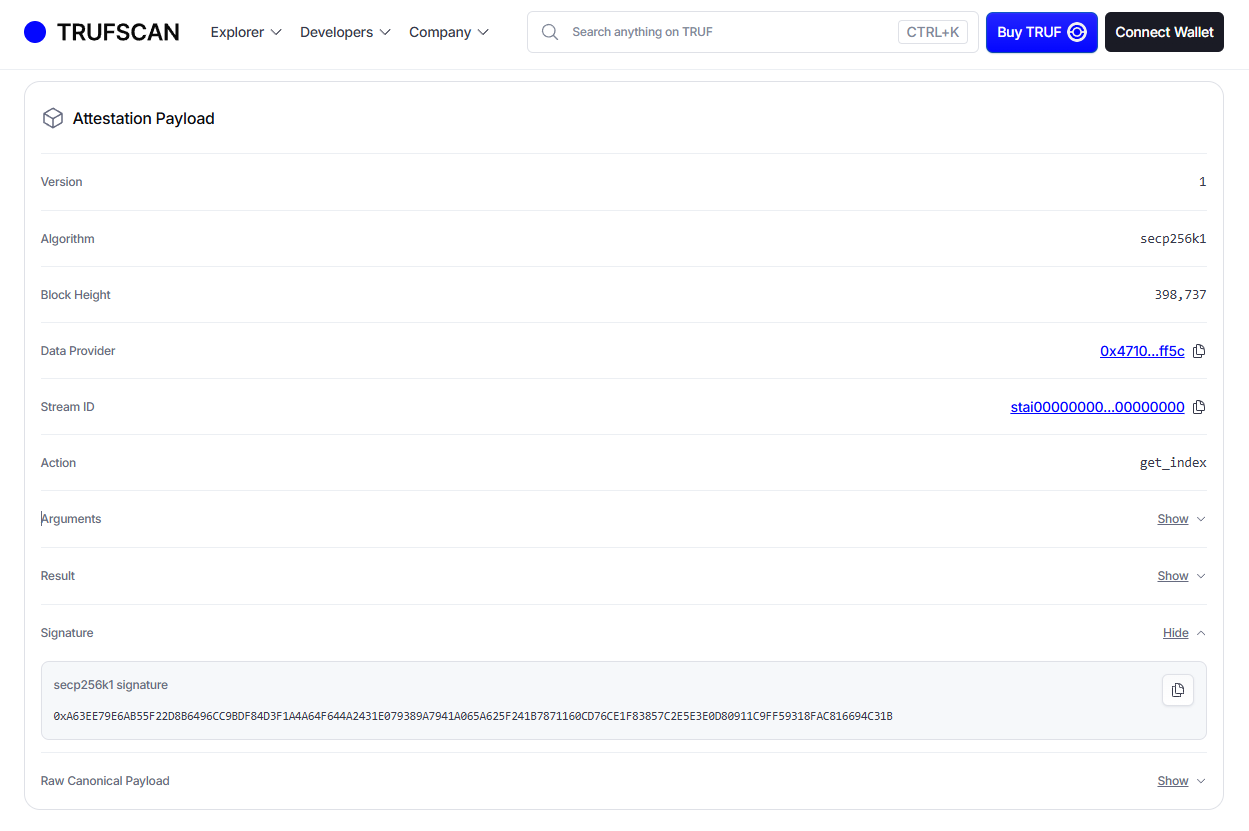
The result is ubiquitous semantic compatibility, across hundreds of existing blockchains and easy integration into applications of all kinds.
Connectivity Friction
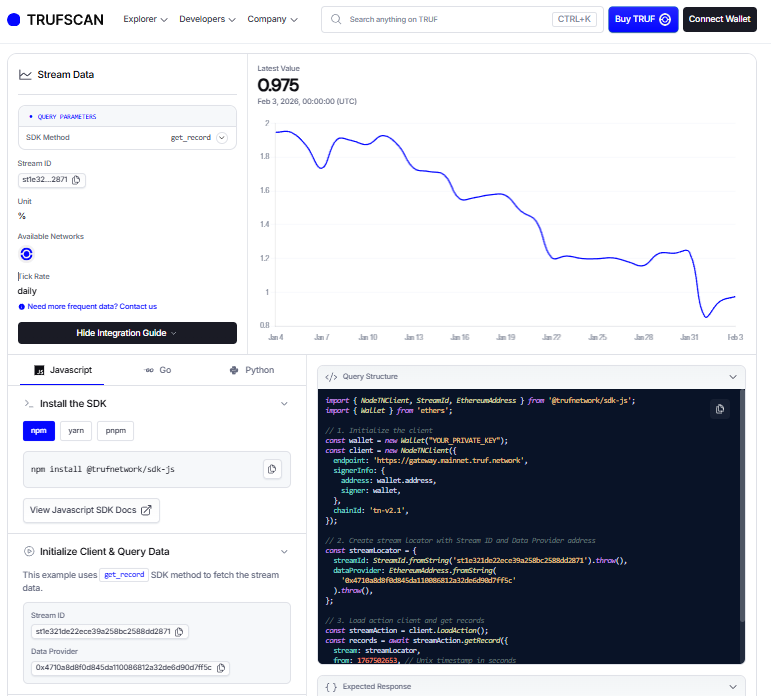
Unlike a centralized API, such as a sportsbook feed that requires a subscription to receive event results, TRUF.NETWORK is a permissionless blockchain network where, with 15 minutes of setup time, anyone can easily run their own node, giving first-class, instant access to not only individual data points that can be used to build prediction markets, but to the most granular level of information about the order books themselves. Since the network is byzantine fault tolerant, all nodes have real-time, unfettered access to the entire network state, stored in a local PostgreSQL database, without any risk of data censorship by third parties. Our developer-first ethos has guided us to not only make the network easy to access and build on, but it is the reason why we offer rock-solid tools - such as SDKs in three languages and an MCP server for AI integration - so that not only have we all but eliminated connectivity friction at the technical level, we’ve done it at the human (or AI agent) level as well.
Liveness
The greatest predictor of future behavior is past behavior. With most providers of event data, their consistency of data provision cannot always be fully ascertained. When first subscribing to a sportsbook results feed, you may gain access to historical scores. However, it may be difficult, or impossible to assure yourself that the data provider delivered those results in a timely manner. On TRUF.NETWORK, in contrast, a node operator can make a simple SQL query and see the provision history of any data stream, down to the second each data point was added to the network. With one-second block times, the network is structured for data providers to add new event data points at high frequency. Whether Truflation offers it’s industry-leading US inflation data on a daily basis or the Bitcoin price every 15 minutes, the network serves the data up live and any result can be used to power a prediction market settlement or any other escrow-like futures transaction on any blockchain, anywhere.
It’s More Than An Oracle, It’s TRUF
TRUF.NETWORK is designed from the ground up to solve the oracle problem through unparalleled data availability. The core promise of blockchain technology, permissionless, trustless interaction, is only fully realized when the necessary external data meets the highest standards of semantic compatibility, low connectivity friction, and liveness. By prioritizing a standardized attestation protocol, a developer-first ethos that minimizes integration time, and a transparent, high-frequency ledger history, TRUF.NETWORK provides the infrastructure for decentralized financial systems to finally interact with the real world on their own terms. For the next generation of prediction markets and decentralized escrow systems, absolute data availability is not a feature, it is the foundational requirement… and TRUF.NETWORK is the new standard.